
China’s industrial-parts strength is not only a story about factory scale. It is also a story about geography. In many product categories, production is organized through regional clusters: dense local ecosystems where manufacturers, material suppliers, process specialists, packaging vendors, testing resources, logistics providers, traders, and export-service teams operate near one another.
For buyers, this matters because a sourcing decision is rarely just a factory decision. It is a decision about the production environment around that factory.
The strongest way to think about Chinese industrial clusters is this:
Clusters are where coordination costs collapse.
That does not mean every cluster supplier is reliable, cheap, or fast. It means a deep cluster can reduce search cost, shorten sampling loops, make backup comparison easier, and give buyers more options when a process, material, packing method, or logistics handover needs adjustment. The commercial value appears only when the buyer uses that density with discipline.
This guide explains the theory behind industrial clusters, maps China’s major sourcing regions by sector, shows how cluster supply chains are layered, and turns the topic into practical sourcing checks. For operational follow-through, pair it with supplier screening, sourcing risk control, quotation comparison, and the CertiRun RFQ workflow.
Benchmark Snapshot
The cluster idea is well established in economic and industrial-development literature:
| Source lens | What it says in practical terms | Why it matters for sourcing |
|---|---|---|
| Porter cluster theory | Michael Porter describes clusters as geographic concentrations of interconnected companies and institutions that can improve productivity, innovation, and new-business formation. | Buyers often experience this as faster supplier discovery, denser benchmarking, and better access to process know-how. |
| OECD regional cluster work | OECD cluster reports emphasize links between firms, skills, institutions, and knowledge flows in the same geography. | A buyer is not only buying low-cost production; the buyer is accessing accumulated local capability. |
| World Bank China cluster analysis | The World Bank links China’s special economic zones and industrial clusters to exports, employment, investment, and industrial upgrading. | China’s sourcing geography grew together with export infrastructure, institutions, and regional specialization. |
| UNIDO cluster development | UNIDO emphasizes backward and forward linkages, support institutions, export consortia, and collective efficiency. | A supplier should be evaluated together with the ecosystem around it: inputs, subcontractors, labs, packing, logistics, and export coordination. |
Useful sources for this framework include Harvard Business School’s page for Porter’s Clusters and the New Economics of Competition, the OECD report Competitive Regional Clusters, the World Bank paper How Do Special Economic Zones and Industrial Clusters Drive China’s Rapid Development?, and UNIDO’s cluster development brochure.
The buyer takeaway is simple: a factory in isolation can be capable, but a factory embedded in a deep cluster is often easier to benchmark, develop, troubleshoot, dual-source, and ship from. The reverse is also true. Cluster density can hide weak suppliers, blurred subcontracting, and documentation gaps if the buyer does not verify the chain.
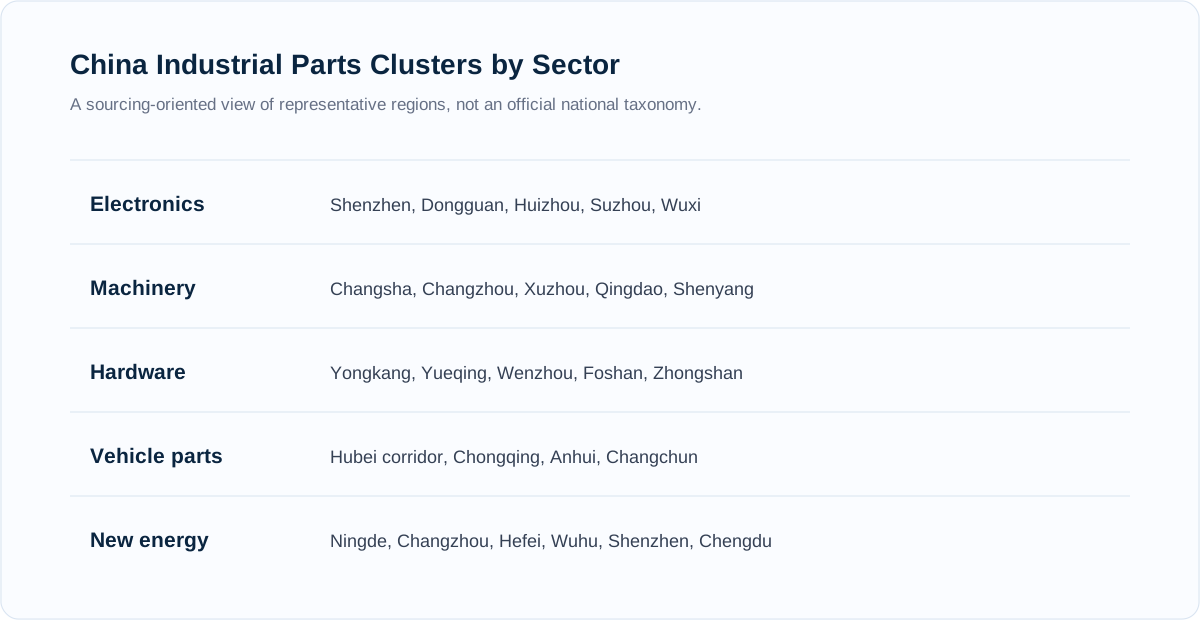
Where China’s Major Industrial-Parts Clusters Sit
There is no single official national database that cleanly maps every industrial-parts cluster into buyer-facing categories. The table below is a sourcing-oriented synthesis of official cluster lists, city statistics, provincial industry documents, and institutional research. It should be read as a practical map for RFQ planning, not as an official taxonomy.
| CertiRun sourcing sector | Representative provinces and cities | Why buyers look there |
|---|---|---|
| Electronics and electronic components | Guangdong Pearl River Delta: Shenzhen, Dongguan, Huizhou; Southern Jiangsu: Suzhou, Wuxi, Nanjing; Fujian: Xiamen and Fuzhou | Deep EMS, components, sensing, industrial electronics, display, PCB-adjacent and export logistics ecosystems |
| Machinery and industrial equipment | Changsha, Changzhou, Suzhou, Wuxi, Xuzhou, Qingdao, Weifang, Shenyang | Engineering-intensive assemblies, construction machinery, power equipment, fabricated structures, automation and process parts |
| Hardware products | Yongkang, Yueqing, Wenzhou, Foshan, Zhongshan, Yangjiang | Metalworking, tools, locks, low-voltage electrical hardware, fasteners, standardized accessories and mid-complexity assemblies |
| Vehicle parts sourcing support | Hubei corridor: Wuhan, Xiangyang, Shiyan, Suizhou; Chongqing; Anhui: Wuhu and Hefei; Changchun | Vehicle ecosystems, commercial-vehicle supply chains, OEM-linked capability, castings, chassis systems, vehicle electronics and NEV transition |
| New energy, PV and EV-related parts | Ningde, Changzhou, Hefei, Wuhu, Shenzhen, Wuhan, Chengdu, Yibin, Shanghai | Batteries, battery materials, BMS, thermal systems, chargers, power electronics, energy-storage and EV-adjacent industrial chains |
This map helps buyers avoid random supplier search. If the RFQ is for low-voltage electrical components, the starting logic is different from an RFQ for welded machinery frames, EV thermal parts, hardware accessories, or electronics assemblies. A good sourcing process begins by matching the product family with the right manufacturing geography, then screening suppliers inside that ecosystem.
Regional Evidence Matrix
The strongest cluster article should not stop at “many factories are close together.” It should show why specific regions matter. The table below keeps the data buyer-facing: scale, specialization, and what that means for sourcing work.
| Region | Relevant sectors | Selected evidence | Buyer interpretation |
|---|---|---|---|
| Shenzhen and Guangdong PRD | Electronics, EMS, industrial electronics, hardware, export manufacturing | Shenzhen’s 2024 GDP reached RMB 3.68 trillion, with secondary industry at 37.8% of GDP, according to the Shenzhen statistics bureau. Shenzhen’s 2024 trade reached RMB 4.50 trillion, according to the city government. Dongguan’s 2024 GDP reached RMB 1.23 trillion, and secondary industry accounted for 55.4% of GDP. | Strong for dense component availability, export-ready suppliers, fast sampling, mixed supplier tiers, and buyers who need electronics or hardware-adjacent sourcing. |
| Southern Jiangsu | Precision manufacturing, electronics, machinery, new energy | Suzhou’s 2024 GDP reached RMB 2.67 trillion. Wuxi’s 2024 GDP reached RMB 1.63 trillion. Changzhou reported 2024 industrial output above RMB 1.7 trillion, with its new-energy ecosystem exceeding RMB 850 billion. | Strong for higher-consistency precision parts, automation, tooling, industrial equipment, electronics-adjacent components, and new-energy supply chains. |
| Yongkang and Yueqing | Hardware, tools, electrical hardware, low-voltage electrical components | Yongkang reported 2024 above-scale industrial output of RMB 104.8 billion and 1,061 above-scale industrial firms. Zhejiang reporting says Yueqing’s electric cluster exceeded RMB 178 billion in 2024, with local supporting rates above 85%. | Useful for standardized metal parts, tools, locks, cabinet hardware, switches, relays, low-voltage electrical items, and orders where supplier density matters. |
| Changsha | Construction machinery, heavy equipment, fabricated systems | A Hunan provincial source describes Changsha’s construction-machinery cluster as exceeding RMB 280 billion in 2021 and accounting for about one-third of national output in that field. Another official article says the local cluster can produce 12 product categories, 100-plus subcategories, and nearly 500 model/specification types. | Relevant for heavy equipment ecosystems, hydraulic-adjacent parts, structural fabrication, machinery modules, and buyers that need process depth around OEM-style supply chains. |
| Hubei auto corridor | Vehicle parts, NEV, intelligent-connected vehicles | Hubei reporting says the province had 25 OEMs, more than 2,400 auto-parts firms, auto-industry revenue above RMB 1 trillion in 2024, and NEV output above 500,000 units. Wuhan reported 2024 NEV output of 334,000 units. | One of the deeper vehicle ecosystems for passenger, commercial, and smart-vehicle supply chains. Useful for category-level vehicle parts sourcing, but still requires fit-for-purpose supplier screening. |
| Chongqing | Auto parts, motorcycles, electronics, inland export manufacturing | Chongqing’s 2024 official bulletin reported RMB 891.2 billion in industrial value-added, 7.3% growth in above-scale industrial value-added, and 26.7% growth in automotive industry value-added. Trade reached RMB 715.4 billion. | Strong for inland automotive, motorcycle, electronics, and multimodal export supply chains, especially when buyers need western-China production footprints. |
| Wuhu and Anhui auto-NEV belt | Auto, NEV, molds, tooling, components | Wuhu reported 2024 vehicle output of 1.635 million units and NEV output of 299,000 units. Anhui provincial reporting says 2024 provincial auto and NEV output reached 3.57 million and 1.684 million respectively. | Attractive for auto/NEV-linked components, molding and tooling, EV systems, and scaling supply chains around Hefei and Wuhu. |
| Ningde battery cluster | Batteries, battery materials, storage, pack ecosystems | Fujian sources say Ningde’s power-battery cluster entered the national advanced-manufacturing-cluster list in 2022. Fujian commerce reporting describes strong global market positions in power, storage, and consumer batteries. | Strong for battery-related sourcing, but buyers should separate access to the regional ecosystem from access to top-tier “chain leader” capacity. |
| Changchun | Auto, NEV, intelligent vehicles | Jilin official reporting describes Changchun’s auto cluster as the largest national advanced-manufacturing cluster in Northeast China and references NEV and vehicle-road-cloud integration progress. | Relevant for OEM-linked vehicle systems and NEV transition, often with stronger OEM gravity than open-market flexibility. |
The source base behind this matrix includes official city statistics and industry pages such as Shenzhen’s 2024 statistical bulletin, Shenzhen’s trade summary, Dongguan’s 2024 statistical bulletin, Suzhou’s 2024 statistical bulletin, Wuxi’s 2024 bulletin, Changzhou’s 2024 bulletin, Yongkang’s industry work summary, Zhejiang reporting on Yueqing’s electric cluster, Hubei’s auto-industry reporting, Chongqing’s 2024 statistical bulletin, Wuhu’s 2024 statistical bulletin, and Fujian’s report on Ningde’s national advanced-manufacturing cluster status.
How a Cluster Supply Chain Actually Works
The easiest mistake is to treat a cluster as a directory of factories. In practice, a cluster gives the buyer access to several layers of capability.
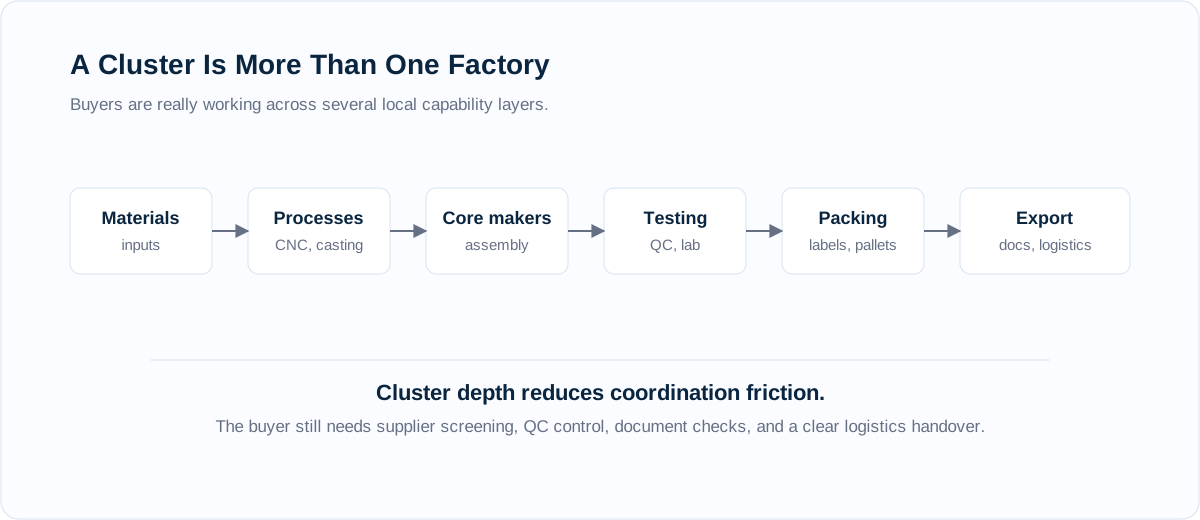
| Layer | Role in the cluster | What buyers should verify |
|---|---|---|
| Materials and components | Metals, resins, PCBs, magnets, battery materials, castings, forgings, blanks, fasteners and semi-finished inputs | Which inputs are locally available, which must come from another province, and which depend on imported material |
| Process specialists | Stamping, die-casting, CNC machining, injection molding, SMT, heat treatment, coating, welding, balancing and testing | Which processes are in-house, which are subcontracted, who approves subcontractors, and who owns tooling |
| Core manufacturers | Finished-product, module, assembly, OEM, ODM, EMS or Tier-1 style producers | Whether the quoted supplier owns key processes or mainly coordinates other factories |
| Testing and compliance | Labs, metrology, certification support, incoming and outgoing quality checks | Whether test reports and certificates match the actual legal entity, site, product family and order scope |
| Packaging and labeling | Export cartons, pallets, crates, anti-rust protection, labels, barcodes, dangerous-goods packing where relevant | Who designs the packing, who pays for changes, and who controls shipment marks |
| Logistics and consolidation | Trucking, warehousing, bonded handling, consolidation warehouses, port/rail/air booking | Where the cargo physically transfers: factory gate, warehouse, port CY, rail station or overseas destination |
| Export coordination | Invoice, packing list, certificate of origin, customs filing, forwarder interface, exporter of record | Whether export documents are controlled by the factory, trader, forwarder or a separate coordinator |
This is where cluster sourcing becomes powerful and dangerous at the same time. A dense ecosystem gives the buyer options. It also gives weak suppliers places to hide process gaps. A quotation may come from one company while material purchase, machining, coating, packing and export documents are handled by several others. That is not automatically bad, but it must be mapped.
What Clusters Change for Buyers
Clusters matter when they improve buyer outcomes. The table below converts the theory into practical sourcing indicators.
| Buyer outcome | Cluster mechanism | Metrics a buyer can track |
|---|---|---|
| Better supplier discovery | More relevant suppliers and process specialists are concentrated in the same region | RFQ response time, number of qualified quotes, number of technically relevant alternatives |
| Faster sampling and rework | Materials, process vendors and technical feedback loops are closer together | Sample turnaround days, engineering-change closure days, pilot-run cycle time |
| Lower coordination friction | Local supporting rates and process density reduce cross-region handoffs | Number of subcontractor handoffs, inbound freight share, open clarification items before PO |
| More flexible sourcing | Backup vendors and specialist processes are easier to compare | Dual-source coverage, alternate-process availability, trial-order MOQ flexibility |
| Better quality problem-solving | Local skill depth and process familiarity can speed root-cause analysis | First-pass yield, AQL fail rate, CAPA closure time, repeat defect rate |
| Cleaner shipment execution | Export-facing clusters often have packaging, forwarding and customs support nearby | Document error rate, shipment-mark mismatch rate, on-time cargo handover |
Notice the careful wording: clusters can improve these outcomes. They do not guarantee them. A buyer still has to clarify the RFQ, verify supplier identity, compare quotes consistently, check process ownership and manage documents.
That is why cluster logic should sit inside a sourcing workflow, not replace it. CertiRun’s Services page frames this work as supplier search, RFQ handling, supplier comparison, document control and shipment follow-up rather than public SKU listing.
How to Use Cluster Logic in an RFQ
Cluster knowledge becomes useful when it changes what the buyer asks for.
Before sending an RFQ, classify the request:
| RFQ question | Why it matters |
|---|---|
| Which product family is this? | Electronics, machinery, hardware, vehicle parts and new energy belong to different supplier ecosystems. |
| Which process creates the main risk? | Casting, machining, SMT, injection molding, heat treatment, coating, packing and testing each point to different cluster strengths. |
| Is the order a repeat replenishment, sample trial or development item? | The best region for a stable repeat order may not be the same as the best region for rapid prototyping or multi-supplier coordination. |
| Does the product need local process density? | Items with many subcontracted steps benefit more from cluster depth than simple products with one stable manufacturing path. |
| Does export packing or documentation carry risk? | Heavy, fragile, plated, electronic, battery-related or labeled goods need stronger packing and document control. |
For example, a buyer sourcing low-voltage electrical hardware should not evaluate supplier geography the same way as a buyer sourcing welded machinery frames or EV battery-adjacent components. The first may benefit from Yueqing-style electrical density. The second may need heavy equipment or fabrication depth. The third may require a new-energy cluster with stronger battery, electronics and safety-document awareness.
This does not mean the buyer should accept the first supplier found in the “right” region. It means the right region gives the buyer a better starting field for supplier screening.
What Buyers Still Need to Control
Industrial clusters reduce coordination cost only when buyers control the right points. The most common cluster-sourcing risks are managerial rather than theoretical.
| Risk area | Why it appears in clusters | Control practice | Useful official tool |
|---|---|---|---|
| Supplier identity | Dense clusters include manufacturers, assemblers, traders and light-asset coordinators | Verify legal entity, business scope, production address, export role and process ownership | China’s market-regulation search portal can be a starting point for entity checks. |
| Hidden subcontracting | A supplier may quote as if it controls the process while outsourcing critical steps | Map in-house and outsourced steps before sample or PO | Require process ownership disclosure and evidence photos tied to the order. |
| Certification mismatch | Certificates may be shown as sales proof but not match the actual site or product scope | Match certificate, legal entity, site, scope and product family | CNCA’s public service platform can support certification checks. |
| Document drift | Factory, trader, forwarder and customs broker may each prepare different document versions | Assign one document owner and review invoice, packing list, HS code and shipment marks before cargo handover | China International Trade Single Window and customs guidance help frame documentation responsibilities. |
| Logistics handover gaps | Cargo may move through factory, warehouse, consolidator, forwarder and port before export | Use named Incoterms, pickup points, cut-off times, VGM/booking responsibility and exception-response rules | Pair Incoterms with shipment SOPs and document-control checkpoints. |
Relevant official portals include the State Administration for Market Regulation search portal, the CNCA certification query platform, the China International Trade Single Window, and China Customs’ process guidance.
This is also where a buyer-side sourcing partner can create value. The work is not simply “finding a factory.” It is clarifying the RFQ, comparing supplier models, checking process ownership, aligning documents, and following the shipment through the handover points. That is the operating logic behind CertiRun’s structured sourcing process and contact/RFQ page.
Claims That Need Careful Wording
Cluster articles often become weak because they overstate the map. A buyer-friendly article should be precise:
| Avoid saying | Safer sourcing-language version |
|---|---|
| ”This is the official map of China’s industrial clusters." | "This is a sourcing-oriented synthesis of official and institutional materials." |
| "This region is always the best place to source this category." | "This region is often a useful starting point for this category, subject to supplier screening and order requirements." |
| "Cluster sourcing always lowers cost and lead time." | "Clusters can improve cost and lead time when buyers use local depth effectively and control supplier execution." |
| "A cluster supplier is automatically reliable." | "A cluster gives the buyer more options, but reliability still depends on supplier verification, QC, documentation and logistics control." |
| "Every cluster has a fully local end-to-end supply chain." | "Supply-chain completeness varies by product family, quality level, material requirement and order profile.” |
This wording matters. It keeps the article credible and protects buyers from treating regional reputation as proof of execution.
How This Article Connects to Other CertiRun Guides
This page explains the cluster model: why China’s industrial-parts geography is regionalized, how the layers work, and how buyers should interpret the sourcing map.
For practical next steps:
- Use How to Identify Reliable Industrial Parts Suppliers in China to screen suppliers inside a cluster.
- Use How to Reduce Sourcing Risk When Buying Industrial Parts from China to build a risk-control workflow.
- Use How to Compare Industrial Parts Quotations from Chinese Suppliers to normalize quotes across suppliers.
- Use How Container Consolidation Improves Cost and Inventory Turnover when the buyer is coordinating multiple suppliers or SKU groups.
- Use Why Inland Logistics Matters in Heavy Cargo Trade when the product is heavy, bulky, fragile or far from a port.
Conclusion
China’s industrial-parts clusters matter because they turn manufacturing geography into sourcing capability. A strong cluster concentrates suppliers, process knowledge, support services, export infrastructure and commercial intelligence in one region. That density can make supplier discovery faster, sampling more practical, quotation comparison richer and logistics coordination more manageable.
But a cluster is not a guarantee. It is an opportunity structure. The buyer still needs to verify who controls production, which processes are subcontracted, how quality is checked, whether certificates and documents match the real order, and where logistics responsibility transfers.
For CertiRun, this is exactly where sourcing execution begins: not with a public SKU database, but with a clear RFQ, category-aware supplier search, disciplined comparison, document control and shipment follow-up. If your team is narrowing supplier search by region and product family, review the CertiRun sourcing service overview, see how the RFQ workflow works, or send details through the structured RFQ page.